.svg)
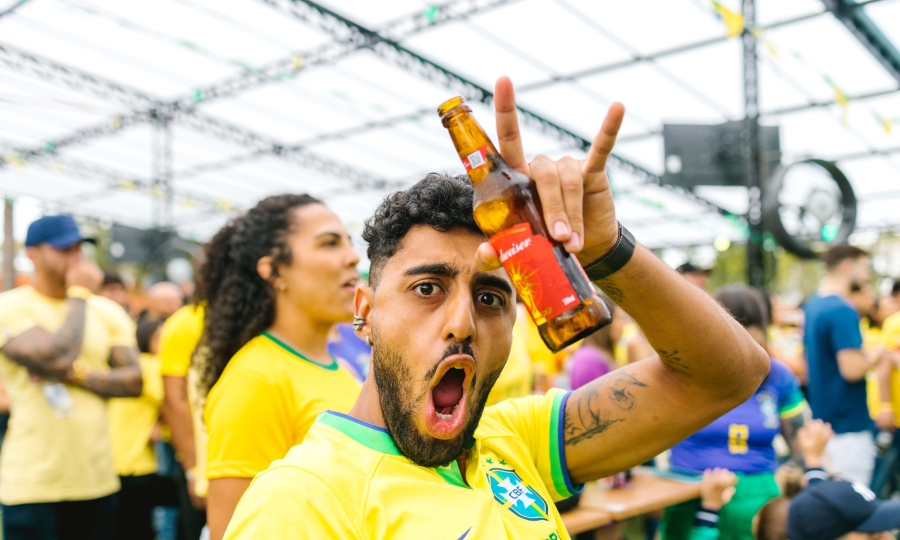
The early-tournament numbers are strong enough that no brand owner should dismiss them as anecdotal noise. According to reporting that cites Beer Institute data, on-trade beer sales in US World Cup host markets are up 15.4% during the 2026 tournament, while on-trade beer sales across the country are up 5.5%. In host markets, draught keg depletions per tap line are up 14.21% versus 6.21% in non-host regions, packaged beer sales are up 19.2%, and stadium beer sales are up 22%. That is not a soft halo - it is a live, occasion-led demand spike.
The local evidence is even more telling. Beer Institute economist Andrew Heritage told WLRN that Massachusetts posted a 27.5% increase in on-premise beer consumption during the opening weeks, the strongest market in the country, helped by Scotland’s matches in the state. In Boston, the demand surge was so intense that the Sam Adams Tap Room had to call in emergency deliveries to avoid running dry. Reuters separately reported that the venue received a special truck delivery after Scotland fans nearly drained supply.
Other host markets show the same pattern, with different local signatures. California’s on-premise beer sales were reported up 17.9% through the early part of the tournament, while Philadelphia’s six World Cup matches drew 409,894 fans who consumed more than 290,000 beers. In Houston, a 16-ounce Michelob Ultra priced at $17.09 became the top-selling concession item, moving 118,196 units and generating more than $2 million in revenue. These numbers matter because they show three different demand engines at work at once - neighborhood bar traffic, citywide fan influx, and premium-priced stadium occasion spending.
Context matters too. This is the biggest FIFA World Cup ever, with 48 teams and 104 matches running from June 11 to July 19 across the US, Canada and Mexico. AB InBev, which extended its FIFA beer sponsorship through 2030, is treating the tournament as a long-cycle global platform, not a one-off summer promotion. That should tell every executive in beverage alcohol something important - the event is large enough to change not just weekly sales, but brand salience and channel behavior.
That is exactly why the current uplift deserves sober interpretation. The World Cup is landing in a category that was already under pressure before the first whistle. The Beer Institute’s May 2026 taxable removals estimate showed shipments down 6.0% year over year. IWSR reported that alcohol beer volumes in the US fell 6% in 2025, and the Brewers Association said overall US beer production and imports were down 5.7% in 2025 while craft brewer volume sales declined 4%.
So the right reading is not that soccer has suddenly fixed beer. The better reading is that the World Cup has exposed where beer still has enormous occasion power when the right ingredients are present - communal viewing, emotional intensity, heavy footfall, long dwell times, and a format mix that spans stadiums, sports bars, taprooms and homes. Even Brewbound’s scan coverage has described the broader retail market as still uneven despite the World Cup uplift, which reinforces the point that the gains are real but selective.
That makes this moment more valuable, not less. When a mature category under pressure suddenly accelerates in specific occasions and geographies, marketers get something rare - a clean read on what still drives conversion. For beer, the signal is that live social sport remains one of the few occasions capable of generating both traffic and trade-up even after years of moderation trends, price inflation and share pressure from adjacent categories.
The strongest signal is format. NIQ reported in May that draft already accounts for 53.1% of US on-premise beer volume and 49.9% of value, putting it on the verge of overtaking packaged beer on dollar share in bars and restaurants. The same report found that draft drinkers over-index on taste, freshness and value, and spend an average of $45 more per month in outlets than packaged-beer drinkers. In other words, the World Cup is not reviving just any beer - it is amplifying the most experiential, highest-visibility format in the channel.
BeerBoard’s opening-weekend World Cup report points in the same direction. It found draft volume up 16% and draft revenue up 17% year over year during June 11-14, while packaged volume rose 24% and packaged revenue rose 25%. Import brands and lagers gained share, and the top draft brands were Michelob Ultra, Modelo Especial, Miller Lite, Coors Light and Bud Light. On the packaged side, Corona Extra, Michelob Ultra and Modelo Especial led. That mix is instructive - light lager, familiarity, refreshment and imported cues are outperforming in a high-energy, highly social sports context.
The second signal is that premium pricing has not killed demand when the live experience feels scarce and culturally loaded. AP reported broad sticker shock over World Cup concession pricing, with many US stadium beers sitting in the mid-to-high teens or above $20 in some venues. Yet host-market stadium beer sales were still reported up 22%, and Houston’s top-selling Michelob Ultra generated more than $2 million at a $17.09 price point. The inference for brand leaders is straightforward - consumers will tolerate premium matchday pricing when the occasion is hard to replicate, but they remain value-sensitive when choosing where to gather in the broader on-premise. NIQ’s REACH study found 62% of consumers planning to watch in bars or restaurants prefer venues with good drink deals or match-day promotions.
The third signal is that moderation is not the opposite of occasion - it is now part of it. Square said bars and breweries saw an 8% revenue increase during the group stage, while non-alcoholic and mocktail options rose 11.8%, outpacing beer’s 8.8% lift in the same data set. IWSR said no-alcohol beer volume in the US grew 15% in 2025 even as alcohol beer fell 6%, and Beer Institute guidance earlier this year pointed to nearly 22% growth for NA beers in 2025. The lesson is not that beer loses when moderation rises. It is that the winning portfolio now lets consumers stay in the occasion longer, whether that means a second pint, a lower-ABV choice or a no-alcohol round between matches.
The first practical lesson is that major sports moments should be planned like temporary route-to-market resets, not just media spikes. Reuters’ reporting from Boston and the Massachusetts data cited by WLRN make clear that inventory readiness and rapid replenishment matter as much as creative. When fan migration is geographically concentrated, cultural fandom can overwhelm normal ordering patterns in a matter of days. For brand owners, that means the commercial playbook has to include tap-line strategy, emergency logistics, local wholesaler coordination and venue-specific forecasting, not just sponsorship assets and social content.
The second lesson is that the World Cup is not a single occasion. NIQ found 58% of consumers globally expect to go elsewhere for drinks before or after the game, and 59% expect to spend more on drinks during World Cup outings than they do on other visits. That implies a broader occasion map - pre-match meet-up, first-pour moment, halftime convenience, post-match celebration, and at-home continuation. Brands that treat every game as one transactional window will leave money on the table. Brands that design assets, menus, bundles and messaging across the full fan journey will capture more value.
The third lesson is that local relevance beats generic tournament branding. NIQ’s guidance for suppliers explicitly says the World Cup requires a localized promotional approach by market, venue, category and pricing. Boston’s Scotland-fueled surge, Philadelphia’s in-stadium volume, and host-city transaction lifts seen by Square in Boston, Philadelphia, Seattle and New York/New Jersey all point in the same direction - the strongest growth sits where local context and fan identity are translated into tailored execution. Global rights can unlock access, but local fan truth unlocks velocity.
The fourth lesson is that on-premise execution still has outsized strategic importance because it shapes what happens later in retail. NIQ notes that bars and restaurants generate roughly half of total beverage alcohol dollars in the US and are where trial converts into off-premise purchase pull. That makes the World Cup especially important for brands looking to recruit younger drinkers, defend premium price architectures, or transfer event-led trial into repeat purchase after the tournament ends. Seen that way, the most important KPI is not only July depletion - it is whether July produces stronger August and September household demand.
For C-suite leaders, the most important takeaway is that the World Cup has functioned like a live stress test for portfolio strategy. Beer still wins when it owns the social ritual, but the subcategories doing the work are revealing. Draft is structurally stronger than many executives may have realized. Imported and familiar refreshment-oriented lagers are disproportionately benefiting from fan energy. Premium venue pricing can hold in high-emotion environments. And no-alcohol options are no longer side bets - they are part of the same commercial system.
That also means the World Cup should change how alcohol companies judge marketing effectiveness. If a brand cannot grow share or visibility during the year’s biggest communal drinking occasion - in a host country, during prime social viewing, with bars full and consumers explicitly more willing to try new drinks - then the issue is unlikely to be a lack of occasion. It is more likely to be a problem of offer, channel fit, creative relevance, distribution or revenue management. That is an inference, but it is strongly supported by the combination of World Cup uplift data, NIQ’s occasion research and the category’s weak pre-tournament baseline.
The alcohol industry came into 2026 needing proof that big cultural moments could still move the needle. It now has that proof. But the more durable opportunity is not the temporary surge itself. It is the strategic blueprint hiding inside the surge - own the occasion, win the format battle, localize with discipline, and build portfolios that let consumers stay in the moment longer. The brands that treat FIFA 2026 as a short-term sales bump will book a nice quarter. The brands that treat it as a real-time operating manual for modern alcohol demand will take something much more valuable into the next cycle
.svg)
Industry intel in your inbox — from major headlines to expert insights, stay ahead in the business of alcohol.

.png)
.png)
.png)
.png)
.png)
.png)

