.svg)
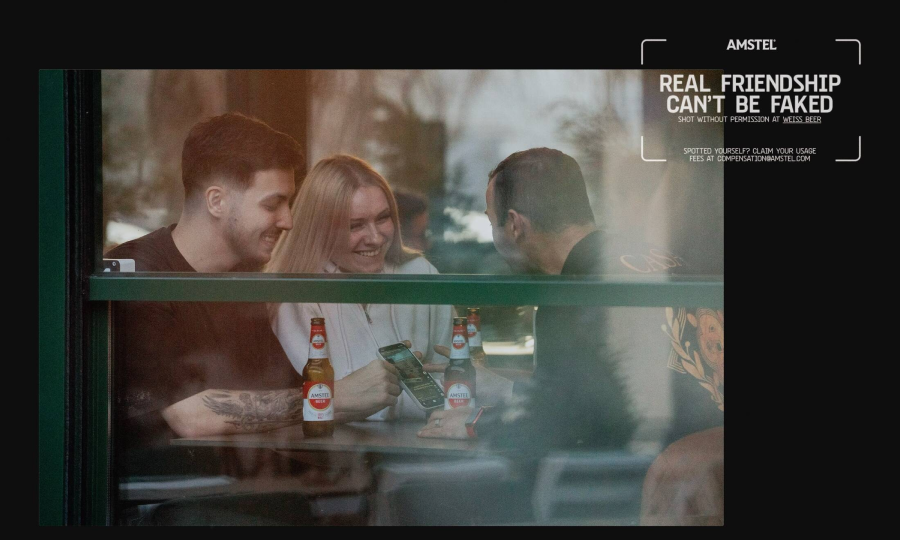
Amstel’s recent “Shot Without Permission” campaign entirely bypasses traditional beer-commercial staging, instead featuring truly candid scenes of friends in neighborhood bars. Created with INGO (part of Ogilvy) and Spanish photographer Javier Tles, the idea was simple: roam real pubs with a camera and quietly capture spontaneous moments - “no scripts, no actors, no direction”. After each shoot, Amstel’s team then approached the people photographed to ask if the images could be used. Crucially, every subject who ended up in an ad signed a release; as one report notes, “nobody is included in the ads without permission”. If anyone declined, their photo was deleted. The resulting out-of-home posters and social posts even invite anyone who spots themselves in a photo to claim a year’s supply of Amstel (essentially paying them “usage fees”). The tone is deliberately countercultural: it presents Amstel as the antidote to the “curated” or AI-generated content that people see everywhere.
In practical terms, Amstel is banking on authenticity. Global Brand Director Vanessa Brandao emphasizes that Amstel was literally founded by friends brewing beer for friends in 1870s Amsterdam - a heritage of real connection. The campaign is meant as a “natural extension” of that ethos, capturing people “as they exist in real life, not as they are usually presented”. Indeed, Amstel’s own research found that about 68% of people feel most like themselves when they’re with close friends. In the age of deepfakes and nonstop social media performance, this campaign signals that the brand values the unpolished, everyday moments where “there is no pressure to perform”. By contrast, most beer ads are highly staged - so Amstel’s “fly-on-the-wall” strategy immediately sets it apart.
However, “shoot first, ask permission later” is a risky gambit that demands careful handling. From a legal and ethical standpoint, using people’s images for advertising normally requires explicit releases or consent. (Indeed, privacy laws in many places - and even rules like GDPR in Europe - treat a person’s likeness as personal data.) Amstel’s team mitigated these concerns by only publishing photos for which consent was eventually obtained. As noted above, everyone whose face appears in the ads ended up signing a release; if anyone had said no, the image was removed. Brandao confirms this: only a “very small minority” declined participation and those images were deleted. This approach aligns with best-practice advice: legal experts recommend getting a signed release from anyone featured in promotional imagery. In short, Amstel inverted the normal workflow but still honored each person’s right to opt out.
Creatively, the campaign earned praise for its honesty. Industry press describes the posters as having “deliberately at odds” visuals - ordinary people in casual dress, half-finished conversations and laughter, all framed by the familiar beers on the bar. Adweek sums it up: real friends, captured without prior notice, enjoying real beer. Daniel Fisher, INGO’s global CCO, points out that they “momentarily break every rule in marketing” by using no casting and “shoot first and ask permission later,” trusting the moments to speak for themselves. Photographer Javier Tles calls the effort “documentary photography, not advertising,” because the images reflect raw human feeling instead of a polished scene. The visual outcome is intentionally imperfect - vintage tees, casual glances, beers half-empty - reinforcing Amstel’s line that “real friendship can’t be faked”.
Ethical & Legal Notes. For brand owners, the key legal point is this: you can photograph in a bar (a private venue), but using people’s likeness in ads always requires consent to avoid privacy or publicity violations. Amstel’s paperwork (and its global teams) ensured compliance after the fact. If this tactic were copied, any marketer should similarly be ready to respect refusal and delete images on request. On ethics, Amstel emphasizes respect: participants signed only when fully informed, and most were reportedly enthusiastic to see themselves on a campaign wall. This suggests that when handled transparently, consumers appreciate being part of a story rather than feeling exploited. (Still, a smaller or less authentic brand might not earn the same goodwill if they tried a surprise shoot.)
Amstel’s stunt taps into a broader industry shift toward authentic marketing. Modern drinkers, especially younger ones, often distrust overly glossy ads. Brands like Carlsberg, Budweiser and others have similarly experimented with “real people” or user-generated themes in recent years to feel more genuine. What makes Amstel’s case notable is its extremity: rather than hiring influencers or staging “real-world” ads, it genuinely gave up creative control. In a world filled with AI-generated and influencer-driven content, standing out with such raw candor can create buzz and media coverage of its own. Early results hint at interest: Heineken says the initiative launched as a test in Argentina and Romania and is already drawing inquiries from other markets. Industry analysts note that this kind of platform (celebrating unscripted connection) aligns with Amstel’s global purpose and resonates on social media, even if it doesn’t directly move sales immediately.
For comparison, many beer ads still rely on playful storytelling or high-production spectacle (think big-budget sports tie-ins, comedy spots, or eye-catching graphics). By contrast, Amstel’s approach is low-fi but high-virality. The campaign has already been covered by multiple ad and trade publications, which itself generates word-of-mouth. It also cleverly gamifies engagement: anyone who recognizes themselves (or their friends) in the photo has a concrete reason to shout about it online for a year’s free beer. In short, the campaign trades scale of reach for depth of engagement and conversation.
For marketing leaders, Amstel’s “Shot Without Permission” offers several takeaways:
Amstel’s “Shot Without Permission” is a striking example of brand authenticity in action. It demonstrates that even a global lager can benefit from guerilla-style authenticity - as long as it stays true to brand purpose and respects legal and ethical boundaries. For any alcohol brand tired of “normal” campaigns, the lesson is: real human moments can resonate more strongly than any scripted scene. Done thoughtfully, this strategy can deepen consumer trust and differentiate your brand in a crowded market.
Key Lessons for Alcohol Marketers:
By focusing on people-first storytelling and respecting participants, Amstel’s campaign delivers a lesson: the most compelling ad content often isn’t “made up” at all, but found in the real, unscripted moments around us.
.svg)
Industry intel in your inbox — from major headlines to expert insights, stay ahead in the business of alcohol.

.png)
.png)
.png)
.png)
%20(1).png)
.png)
.png)
.png)